

PHP to IOP Step Down: How to Know When You're Ready to Make the Move
TL;DR
A PHP to IOP step down is a planned part of treatment, not a graduation test you pass or fail.
Readiness shows up in stability: steady attendance, managed cravings, a safe place to live, and a working relapse-prevention plan.
Your clinical team makes the call using a level-of-care assessment based on the ASAM Criteria, and your voice is part of it.
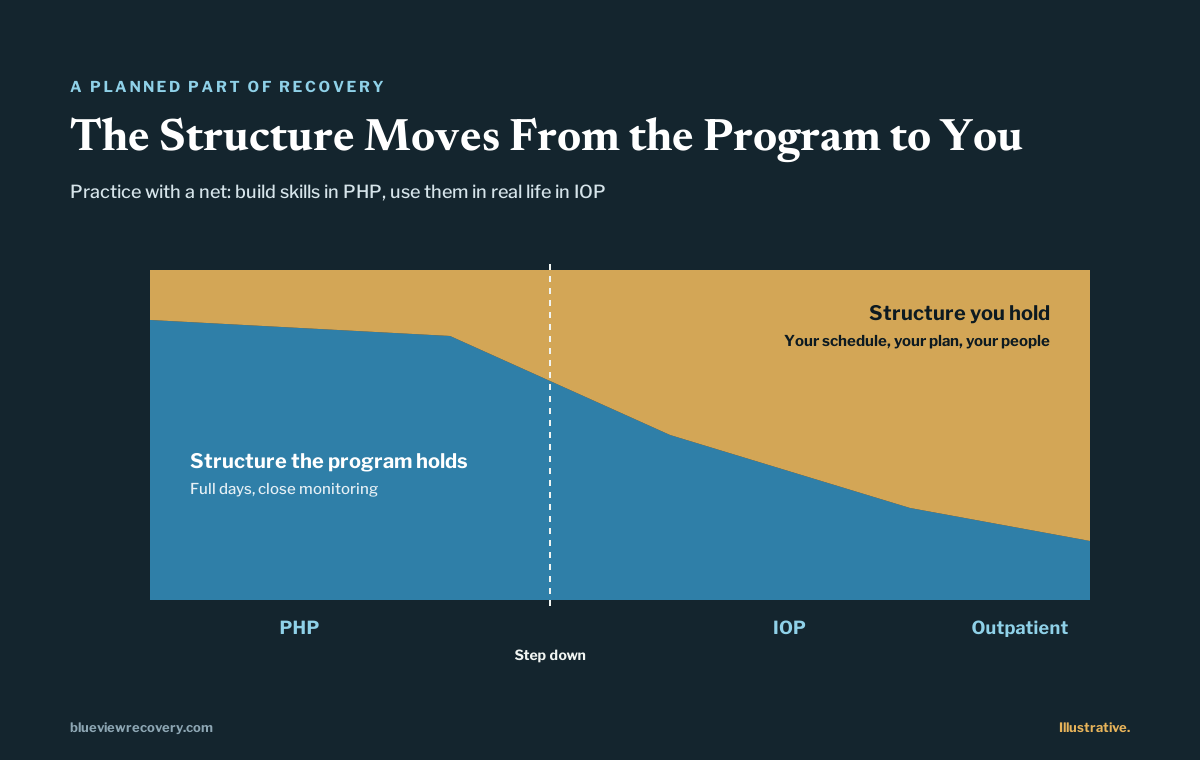
IOP usually leaves your days open for work, school, and family. The structure moves from the program to you.
If you stumble after the move, you can often return to a higher level of care. That is an adjustment, not a failure.
Table of Contents
How your clinical team decides: level-of-care assessment and ASAM Criteria
How to prepare for the transition and build a relapse-prevention plan
Introduction
Somewhere in your second or third week of partial hospitalization, a new thought shows up. Maybe you're feeling better. Maybe you miss your own bed. Then a harder one follows: what if I'm not ready for less?
That worry is normal, and it is the right question to ask. A PHP to IOP step down is one of the biggest transitions in treatment, because the hours drop and the daily structure shifts from the program to you. This article explains how to tell when you're ready, how your team decides, and what to do so the move holds. If you're a family member, it will help you understand what you're watching for.
What PHP and IOP are and how they differ
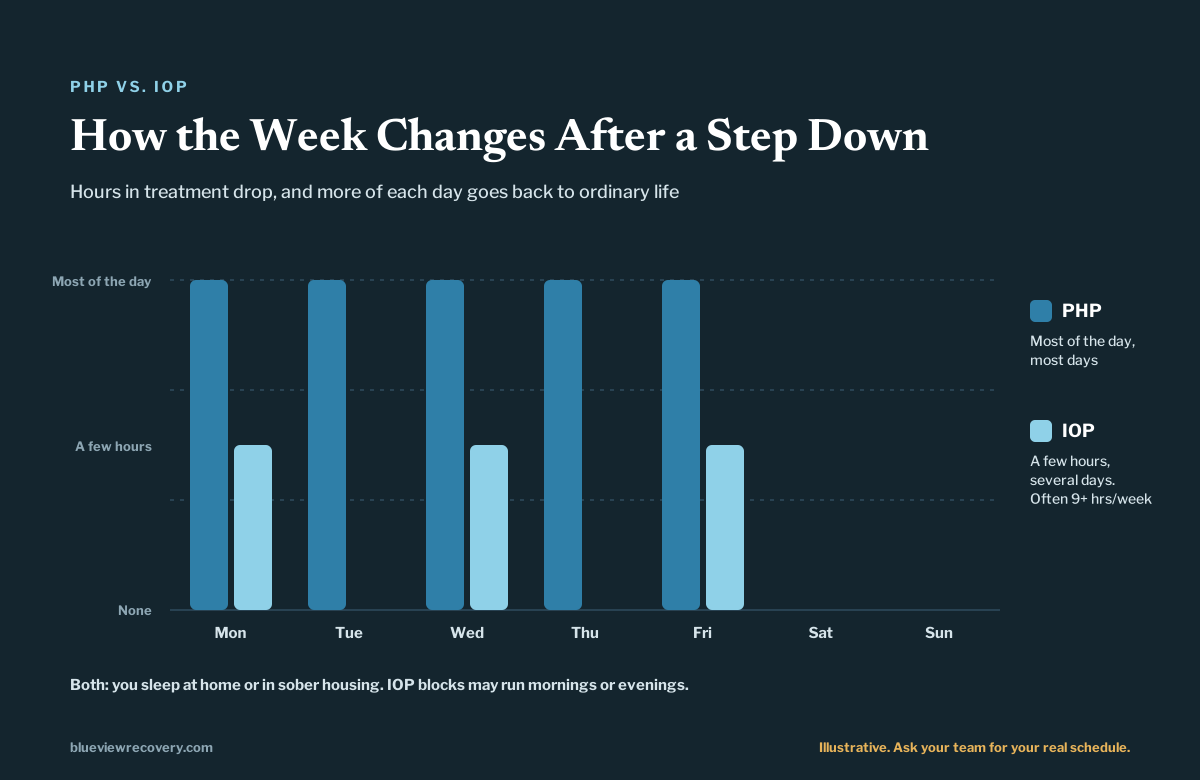
Partial hospitalization is the most intensive form of day treatment. You attend programming most days of the week for several hours a day, then go home or to sober housing at night. Intensive outpatient is the next step down: fewer hours, usually nine or more a week, with more of your day left for ordinary life. You can read about our partial hospitalization program and our intensive outpatient program in King of Prussia for specifics on our own schedules.
Feature | PHP | IOP |
|---|---|---|
Typical time in program | Most of the day, most days of the week | A few hours per session, several days a week |
Medical and psychiatric access | Frequent, easy to reach | Scheduled, with check-ins |
Who it suits | Needs daily structure and close monitoring | Stable enough to practice skills at home, work, or school |
Where you sleep | Home or sober housing | Home or sober housing |
Exact hours vary by program, so ask your team what yours looks like.
Why a PHP to IOP step down is a planned part of recovery
Treatment is built in levels so you can move to the one that fits your needs right now. The American Society of Addiction Medicine (ASAM) describes its criteria as guidelines that take a person-centered approach to building treatment plans for addiction and co-occurring conditions.[1] Moving between levels is how that plan works in practice.
Think of it as practice with a net. In PHP you build skills while someone watches closely. In IOP you use them in real life, and the team is still there to catch what goes wrong. A well-timed PHP to IOP step down gives you that second phase. If you came to us after medical withdrawal, our post on detox vs rehab covers why treatment continues past that first stage.
Signs you may be ready to step down to IOP
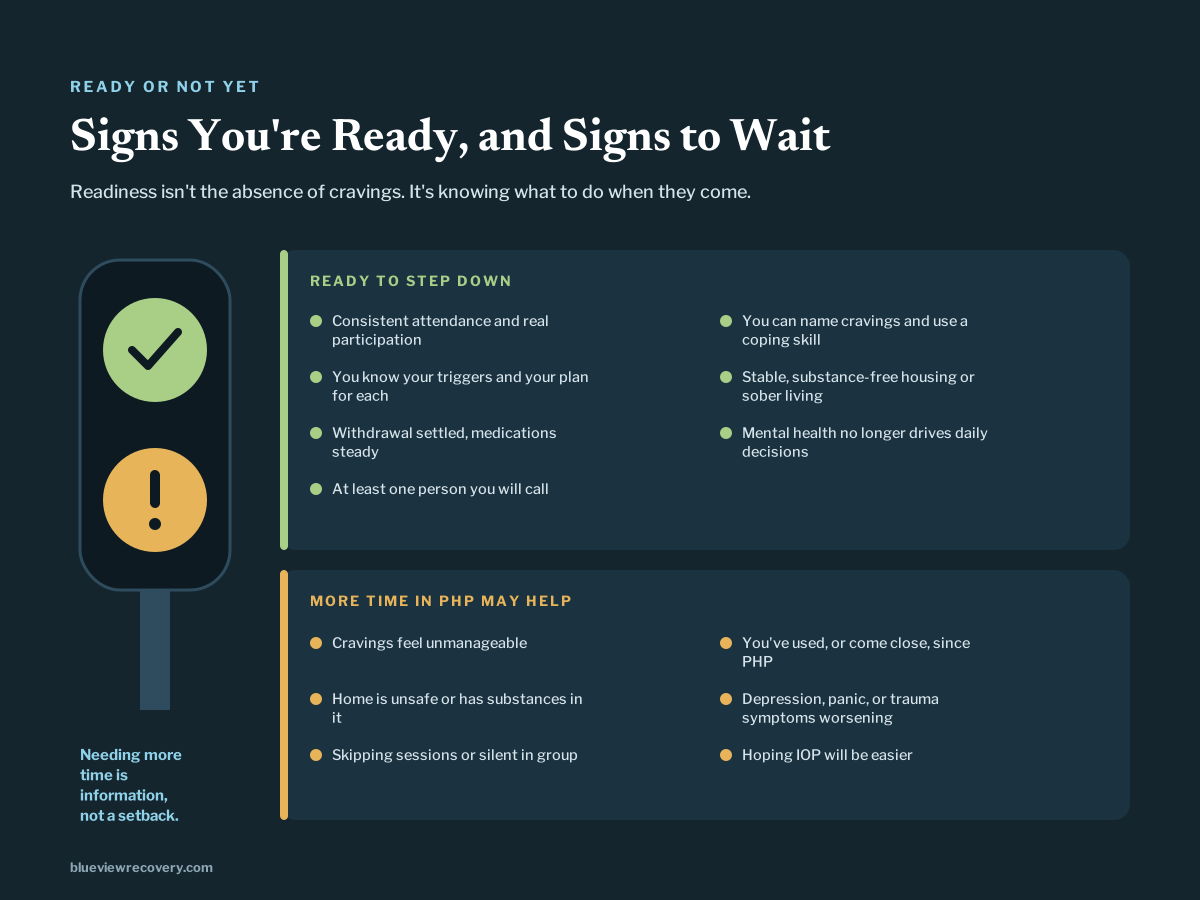
Readiness is not the absence of cravings. It is knowing what to do when they come. Your team looks for these signs:
You attend sessions consistently and take part, rather than just showing up.
Cravings come, and you can name them, ride them out, and use a coping skill.
You can describe your triggers and what you will do about each one.
You have stable, substance-free housing, or a place in sober living (see our guide to sober living vs halfway house).
Any withdrawal symptoms have settled, and your medications, if you take them, are steady.
Mental health symptoms such as anxiety or depression are under enough control that they no longer drive daily decisions.
You have at least one person you will call when things get hard.
Families often notice these before the person does. Steadier sleep, less irritability, and honest conversation are real signals. Treatment for opioid use may also include medications, which NIDA describes as safe, effective, and life-saving.[2] Staying on them through the transition is part of being ready.
Signs you may need more time in PHP
Wanting to leave is not the same as being ready to leave. Some signs suggest a PHP to IOP step down should wait a little longer:
Cravings still feel unmanageable or lead to thoughts of using.
You have used, or came close, since starting PHP.
Home is unsafe, with alcohol or drugs in the house or people who pressure you to use.
Depression, panic, or trauma symptoms are getting worse, not better.
You are skipping sessions or sitting silent in groups.
You are hoping IOP will be easier rather than ready for it.
Needing more time is not a setback. It is information. If mental health symptoms are part of the picture, our mental health PHP and dual diagnosis treatment address both conditions together.
How your clinical team decides: level-of-care assessment and ASAM Criteria
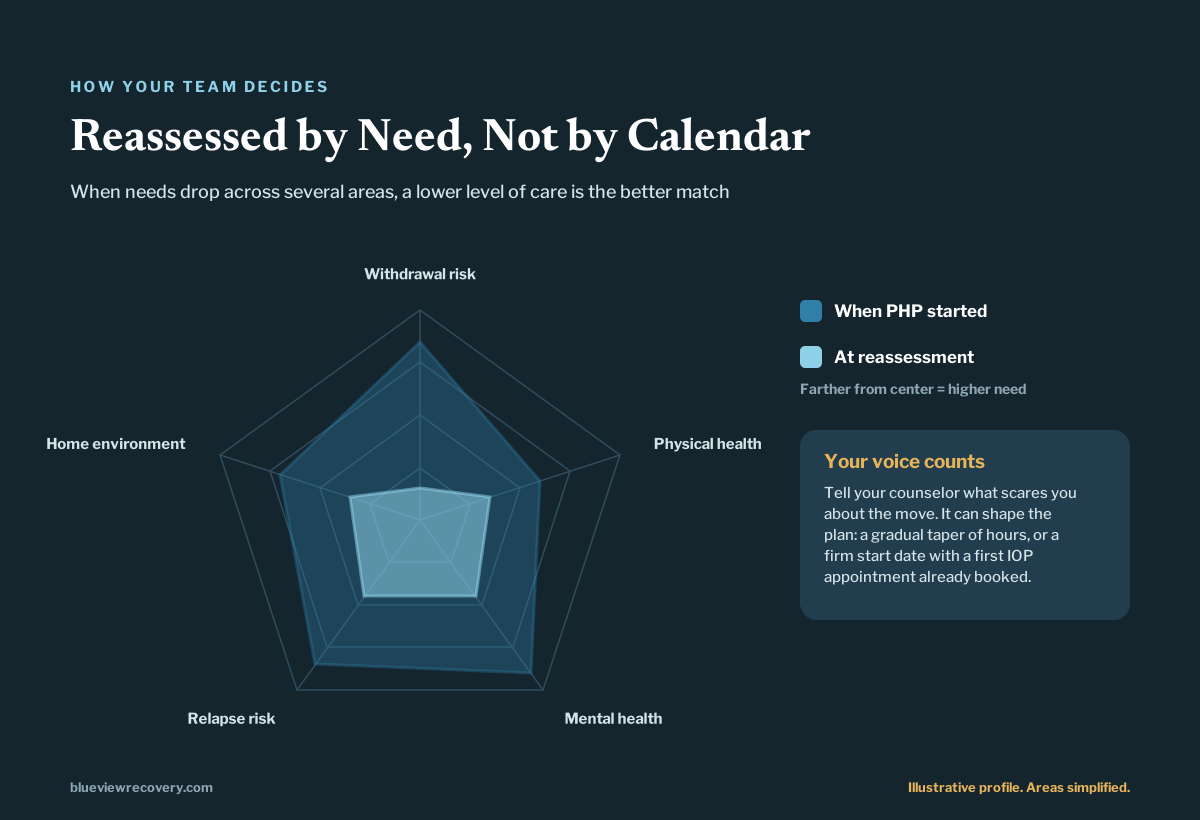
Your team does not pick a date from a calendar. They reassess you against the ASAM Criteria, which look at several areas of your life, including withdrawal risk, physical and mental health, readiness to change, relapse risk, and your living environment.[1] If your needs have dropped across those areas, a lower level of care is the better match.
You are part of the decision. Tell your counselor what scares you about the move. That fear is useful information, and it can shape the plan, such as a gradual taper of hours or a firm start date with a first appointment already booked.
For questions about alcohol in particular, NIAAA offers a treatment navigator and information on alcohol use disorder that can help families understand what good care looks like.[3] If you need to find care options near you, SAMHSA runs FindTreatment.gov and a national helpline.[4]
What to expect in IOP: schedule, therapy, and daily life
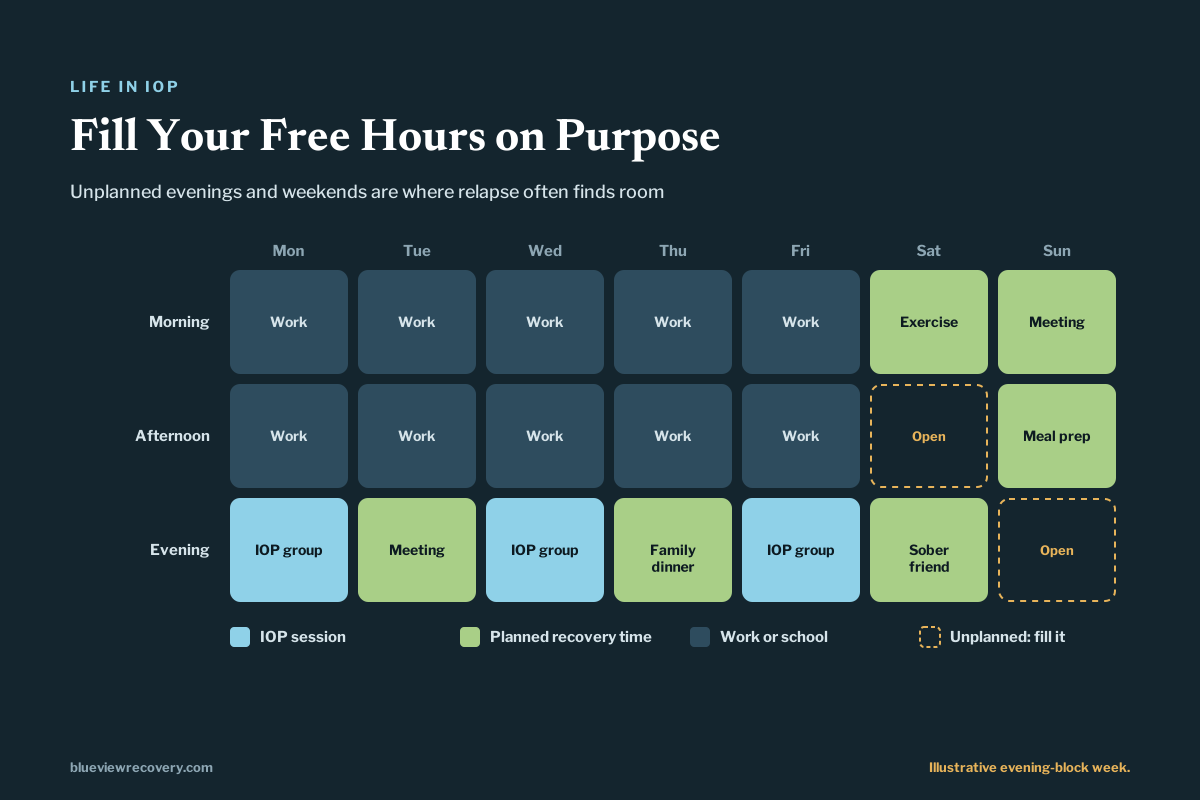
Most IOP schedules run a few days a week, in either morning or evening blocks. That means you can often keep a job, attend classes, or be home when your kids get off the bus. If commuting is a barrier, a virtual IOP may fit better.
Your week usually includes:
Group therapy, where you practice skills and hear how others handle the same problems.
Individual sessions, often weekly, to adjust your plan.
Family sessions or education when appropriate.
Medication management if you take medication.
The hard part is the extra free time. In PHP, your day was full. In IOP, evenings and weekends are yours, and unplanned hours are where relapse often finds room. Fill them on purpose. If work is a concern, our posts on FMLA and rehab and job protections explain your rights. For mental health support alongside recovery, we also offer mental health IOP.
How to prepare for the transition and build a relapse-prevention plan
Start preparing a few weeks before your PHP to IOP step down, not the night before. A workable plan is specific and written down:
Triggers and responses. List your top five triggers and one action for each.
Daily schedule. Plan every weekday and weekend block, including meals, meetings, and exercise.
Support contacts. Write three names and numbers, plus the 988 Suicide & Crisis Lifeline listed by SAMHSA.[4]
Warning signs. Note what early slipping looks like for you: isolating, skipping meals, lying about small things.
Emergency steps. Decide in advance whom you call and what you do if you use.
Families can help by agreeing on how to talk about warning signs without blame. If you are worried about someone not yet in care, our guide on suggesting recovery to a loved one may help. And if cost is a worry during the move, see how to pay for rehab without insurance.
Frequently Asked Questions
Q: How long do people typically stay in PHP before stepping down to IOP?
A: It varies by person. Many people spend a few weeks in PHP, but the right length depends on your assessment, not a fixed number. Your team reviews progress regularly and recommends a PHP to IOP step down when your needs support it.
Q: What is the main difference between PHP and IOP in hours and structure?
A: PHP is most of the day on most days of the week, with frequent clinical contact. IOP is a few hours per session on several days a week, with scheduled check-ins. You sleep at home or in sober housing in both.
Q: Can I step down to IOP too early, and what are the risks?
A: Yes. Moving too soon can leave you with more free time and less support than you can handle, which raises the risk of relapse. If this happens, tell your team quickly. Returning to a higher level of care is a legitimate option.
Q: Will I still be able to work or attend school during IOP?
A: Often, yes. IOP sessions are usually a few hours at a time, in morning or evening blocks, so many people keep a job or classes. Tell your team your schedule so they can match you to the right block.
Q: What happens if I struggle or relapse after moving from PHP to IOP?
A: Call your counselor right away and be honest about what happened. Your team will reassess and may add sessions, adjust medication, or move you back to PHP. A slip is a sign that your plan needs changes, and it is better handled early.
Conclusion
A good PHP to IOP step down is based on stability, not impatience. You are ready when you can manage cravings, you have a safe place to live, and your relapse-prevention plan is written and rehearsed. You need more time when those pieces are still shaky, and that is a normal part of treatment.
If you are in PHP and wondering about your next step, or you are a family member trying to understand it, Blueview Recovery can help you sort it out. Call us or visit blueviewrecovery.com to talk with our team about your assessment and what the move to IOP could look like for you.
References
American Society of Addiction Medicine. ASAM Criteria, 4th Edition and organization overview. https://www.asam.org
National Institute on Drug Abuse. Medications for opioid use disorder and treatment resources. https://nida.nih.gov
National Institute on Alcohol Abuse and Alcoholism. Alcohol use disorder and treatment navigator resources. https://www.niaaa.nih.gov
Substance Abuse and Mental Health Services Administration. Helplines and treatment locators (FindTreatment.gov, 988 Suicide & Crisis Lifeline). https://www.samhsa.gov